


20 Years of History
Interview with the Chairman of the Board of Directors
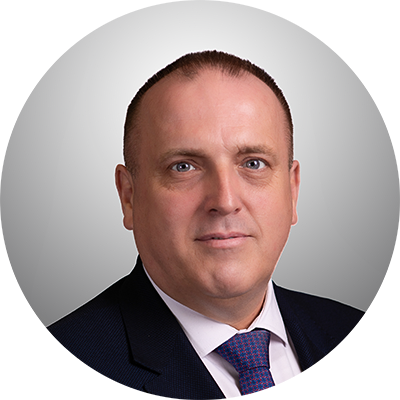 |
RNDr. Peter Gerhart, PhD. |
Today, we aspire to shape the future of nuclear energy
JAVYS has evolved from activities in the back end of the nuclear energy cycle into a company with the ambition to participate in new, innovative nuclear projects. Chairman of the Board of Directors RNDr. Peter Gerhart, PhD., talks about a mental transformation, key moments, and why the company’s future is inextricably linked to courage.
Do you still remember your first day in the environment we now know as JAVYS?
I remember it quite clearly. It was 1 July 2003, when I joined Slovenské elektrárne, specifically the VYZ plant, which was part of the company and handled activities related to decommissioning, the management of radioactive waste (RAW) and spent nuclear fuel (SNF), and the disposal of conditioned low-level waste. The first day went completely by the book—a medical exam, induction training, introduction to my supervisor, and a tour of the workplace.
Based on an advertisement, I applied for the position of specialist in radioactive waste management in the A1 NPP decommissioning project. I was already interested in this field back then because it combined technical complexity, safety aspects, and a certain “unexplored” area. It’s important to realise that at that time, the culture at Slovenské elektrárne was such that specialists were often former directors or deputy directors and high-level experts. I was among the youngest to enter this field “from the bottom up.”
And paradoxically, that’s exactly what opened up a huge opportunity for me to learn. My colleagues were people with decades of experience behind them—experts who had also worked in an international environment. I’d like to mention Mr. Pietrik, Mr. Adámek, Mr. Kršteník, and Mr. Hudcovič in particular. For me, it was like a second university. I literally absorbed every discussion, every meeting, and every argument. This was one of the most important periods for me; it was formative.
I would wish for everyone to experience such a period at the beginning of their professional career.
The decommissioning of the A1 nuclear power plant was a completely unique project—not only technically, but also because it was a field that was still being defined. How did you perceive this phase?
I saw it as a unique opportunity. It’s important to realise that decommissioning at that time was not a standardised discipline, as it is today. In 1979, when the federal government of the Czechoslovak Socialist Republic decided on its permanent shutdown, there was no legislation, no detailed international manuals, and even the International Atomic Energy Agency did not yet have clearly defined procedures for what exactly decommissioning a nuclear installation entails. It wasn’t until the 1990s that this began to slowly change. The real boom didn’t occur until after 2000.
In this sense, the decommissioning of the A1 NPP was a “learning experience.” Although the project was progressing, it was still operating in an environment where many things were being created and resolved on the fly. This placed great demands on analytical thinking, discussion, and the ability to find solutions.
I joined the project to bring the A1 NPP to a radiation-safe state. I remember meetings where problems were analysed in such detail that it took hours of discussion to arrive at a solution that was logical, technically sound, and practically feasible. For me, as a young person, it was fascinating. Issues regarding the deployment of additional technologies for radioactive waste treatment were addressed. Procedures for handling contaminated concrete and soil were defined. A site was being sought for the construction of an integral storage facility. Of course, the primary task was to ensure liquid radioactive waste treatment and conditioning, or to prepare measures for its subsequent safe storage.
At the same time, the first discussions about the future decommissioning of the V1 NPP had already begun. It wasn’t yet a dominant topic, but some experts already sensed that another major project lay ahead. Basic concepts were discussed—for example, to what extent the plant would be decommissioned. I should note that this was at a time when the overwhelming majority of people did not believe that the V1 NPP would be decommissioned. The political rationale was unacceptable to everyone.
The year 2006 marked the establishment of JAVYS as an independent entity. How did you perceive this moment from the inside—as someone who was directly involved in the transformation?
Interestingly, from my personal perspective, it wasn’t a dramatic turning point at first. It wasn’t as if I perceived it as a “historic moment”. I basically received two letters—one regarding my transfer and the other welcoming me as an employee of the new company.
Of course, in the broader context, it was a fundamental step. JAVYS was established as a result of the privatisation of Slovenské elektrárne, and it was necessary to separate the activities related to decommissioning, waste management, and spent fuel. Each of the potential investors had a different view on what they wanted to privatise and what they didn’t. The result was the creation of a separate entity that oversaw these activities.
Looking back, I consider this a very sound decision. If these activities had been fragmented or weakened, JAVYS would never have achieved its current position. The integrated model—decommissioning, fuel, waste, and disposal—laid the foundation for the company’s technical and market strength.
From the perspective of the company’s atmosphere, however, it must be said that older employees in particular felt a sense of uncertainty. They asked what would happen next, what the future would hold. Personally, I didn’t perceive it that way, because I was fully immersed in work on the A1 NPP decommissioning project.
The transformation from a large state-owned organisation into a smaller, independent entity often changes the management culture as well. Have you noticed any specific changes in how things operate?
Yes, and it was quite noticeable. For example, it was the first time I saw the CEO in person at Jaslovské Bohunice. It’s a small detail, but symbolically very important. At Slovenské elektrárne, the hierarchy was more distant, whereas at JAVYS, management has moved closer to operations.
At the same time, a sense emerged that “we’re in control.” We were no longer just part of a large whole where we had to adapt to global plans, but an organisation that could set its own priorities. This brought greater responsibility, but also greater flexibility.
If you were to identify key milestones in the history of JAVYS, which moments do you consider the most significant in terms of the company’s direction?
There are several, but some are truly decisive. The first was the arrival of the management team that gave the company a clear structure and direction. Peter Čižnár played a significant role here. Processes, an organisational structure, and a management style were established that essentially still function today.
The second, and for me personally the most crucial, was entering the realm of international commercial activities. Until then, JAVYS had operated primarily as an organisation that “did what was necessary and what sort of came our way on its own”. The decision to enter the free market marked a fundamental shift in mindset. At that time, I moved from the position of head of the investment department, where I “basically gave out money”, to a position where I had to try to acquire it.
That’s a completely different mindset. Not every manager or employee was able to handle it—or even can handle it now. For me, it was a challenging period, but also a very formative one.
Looking back, it can be said that without the launch of commercial projects, we wouldn’t be working on the advanced modular reactor project today.
A pivotal moment for the company was the systematic launch of the decommissioning of the A1 NPP in its second phase. That was the moment when decommissioning became a full-fledged project with all the necessary components—planning, management, and oversight.
And, of course, the shutdown of the V1 NPP in 2006 and 2008. That was a huge turning point, both psychologically and professionally. People who had spent their entire lives operating the power plant had to shift their focus to decommissioning it. This isn’t just a technical change; it’s a mental transformation.
It is precisely this “mental transformation”—the transition from operation to decommissioning—that is often cited as the key challenge. What did it entail, and how did it manifest in practice?
It was one of the most demanding processes. Imagine a person who has spent their entire life working on a facility with the goal of ensuring its safe and reliable operation. And suddenly, overnight, they have to dismantle that facility. That conflict is both internal and professional. Some people were able to cope with it more quickly, others more slowly. Real progress only came when new people started arriving who didn’t have that professional history or “emotional attachment” to the operation. They approached decommissioning as a standard project—a technical problem that needed to be solved. And it was precisely the combination of the older generation’s experience and the younger generation’s pragmatic approach that ultimately enabled progress.
How has the approach to safety changed over the years—particularly in the context of the transition from operation to decommissioning and the impact of international events?
Safety has always been paramount. It cannot be said that it is “higher” or “lower”. That would imply that it was insufficient in the past, which is not true. What is changing is the scope and depth. Following events like Chernobyl or Fukushima, requirements are gradually expanding, new standards are being introduced, and new, broader perspectives on safety culture are emerging. Today, safety is more complex, more layered. But its fundamental principle—absolute priority—was the same twenty years ago.
If you were to characterise JAVYS today, after twenty years of existence—where does the company stand, and what is its character?
To me, it most closely resembles a human life. The company has gone through a period of searching, growth, and maturing. Today, it is at a stage where it knows where it stands, understands its role, but at the same time has the ambition to move forward.
Perhaps I would compare it to a person in their thirties—they’ve already been through a lot, but they still have the courage to take on new things. And that is key. Because today, JAVYS is facing projects that go beyond traditional decommissioning. We’re talking about new nuclear power sources, advanced reactors, and deep repositories. These are strategic challenges.
Do you think it is right for JAVYS to venture into new areas—such as the construction of new nuclear power sources or advanced technologies?
Absolutely yes. I consider it essential, even strategic. Over the past twenty years, JAVYS has accumulated unique know-how—in the areas of decommissioning, waste management, and spent fuel management. There are people here who have gained a tremendous amount of experience. It would be a pity not to make use of this experience. At the same time, the reality is that decommissioning projects have their own lifecycle. And if a company is to function and grow in the long term, it must have new challenges.
And honestly—creation is always more attractive than “demolition”. Although decommissioning has its own significance and expertise, building new projects brings a different kind of energy, motivation, and strength.
That is why it is natural for JAVYS to shift from an organisation that “closes the door on the past” to one that helps shape the future of nuclear energy in Slovakia.
Looking back on this entire journey, what do you consider to be the greatest contribution of JAVYS to Slovakia?
The ability to tackle something that didn’t have a clear definition twenty years ago. Decommissioning nuclear facilities, waste management, disposal, and spent fuel handling—these are all areas critical to the safety and credibility of nuclear energy.
JAVYS has not only managed to ensure these activities but also to systematically develop them and bring them up to a level that is at least comparable to international standards.
And today, it faces the next step—using this experience to be part of building a new energy future. This is the natural continuation of this journey.